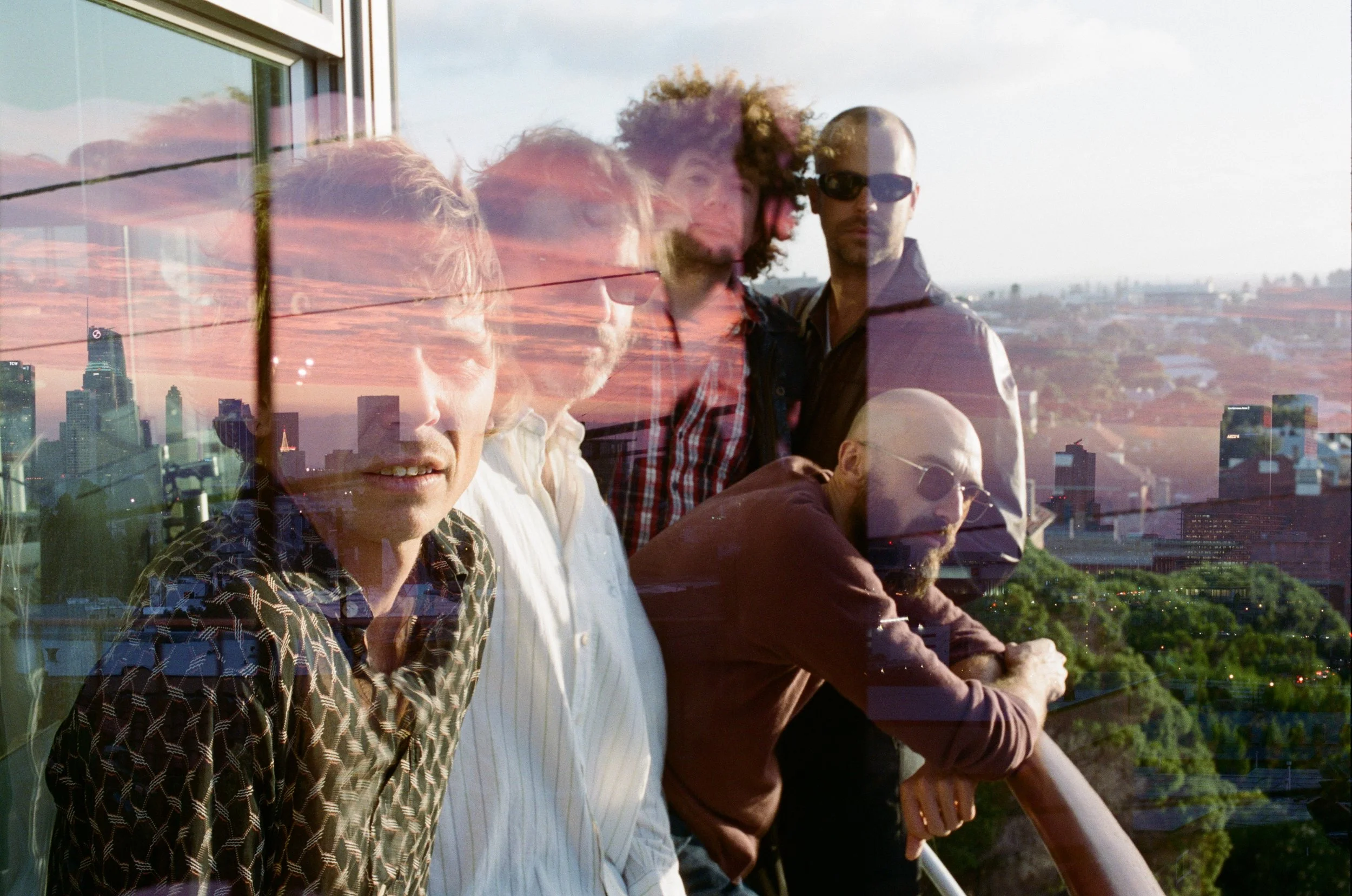
Photography: Kristofski
POND
on their latest album Terrestrials, Australian darkness and the freedom of limitations
Written by Siena Robb
There is a particular kind of darkness that belongs to Australia. A darkness that exists beneath a violently blue sky, across an empty plain, beside a suburban carpark. One that somehow feels more unsettling for having nowhere to hide.
For Pond’s Nick Allbrook, that contradiction runs through the band’s eleventh studio album, Terrestrials.
“It’s a very unsettling darkness in Australia, because it is very very bright, lonely and quiet,” he tells MAESI. “The reality of the country’s history is terrifying enough.”
It is an idea that reaches beyond the sound of Terrestrials. Across its ten tracks, Australia is not simply the backdrop against which Pond’s latest incarnation exists. It is tangled through the record: in its landscapes and people, its humour and ugliness, and in the complicated affection of writing about somewhere that can inspire pride and shame almost simultaneously.
For Allbrook, that specificity is instinctive.
“I like lyrics that are pretty concrete I think, words whose imagery or sense of place puts you in the movie, even if the movie is stuffed,” he says. “Without that it can drift into a kind of emotional obscurity.”
The places and images scattered through Terrestrials are strikingly specific. Allbrook recalls driving across the Roebuck Plains on his way home for the first time in a decade; hearing about Darwin’s whaling industry from an old bloke who had passed out at a bus stop in Fremantle; Rio Tinto’s destruction of Juukan Gorge and the government kickbacks surrounding an industry inseparable from Western Australia’s identity.
These aren’t references added afterwards to make an Australian record sound Australian. They are simply the things occupying the world Allbrook is writing from.
“So instead of writing about ‘homecoming’ or ‘climate change’ or whatever, it comes from some big feeling – anger or love or sadness – that needs reflection,” he explains. “So it just sort of ends up hyper Australian because that’s my life and my identity, whatever the f*ck that means.”
That last qualification might be the most important part. Terrestrials doesn’t attempt to determine exactly what Australian identity means. If anything, the record seems increasingly suspicious of the idea that such a contradiction could ever be resolved neatly. There is affection here, but little romanticism. Asked how he navigates writing critically about somewhere he knows so intimately, Allbrook rejects the suggestion that there was ever a map.
“I didn’t really navigate it at all. That would suggest some sort of compass, where I was, as usual, psychotically pin-balling between elation and horror.”
For Allbrook, pride and shame aren’t opposites so much as feelings capable of occupying the same space. He describes a sense of pride in what “the fucked-up ghouls of Van Diemen’s Land” wrought from bleak suffering, immediately complicated by shame at the silence and apathy with which that history can now be covered. It’s messy. Terrestrials allows it to remain that way.
That refusal to clean things up is particularly apparent on “Skyworks” and “Two Hands”, two songs that confront loaded parts of Australian history and culture without losing the humour, eccentricity and occasional ridiculousness that have always made Pond sound like Pond.
Allbrook doesn’t consciously ration those qualities.
“I don’t really measure it out like a recipe to be honest,” he says. “I’m not taking a little taste of a teaspoon like ‘hmmm, needs more funny’.”
Instead, he writes from his own perspective and accepts whatever combination emerges: emotional, social, political, fantastical, sentimental, silly and erratic. He is equally wary of positioning himself as someone with the answers. Whatever he writes, he jokes, will “DEFINITELY not offer up any serviceable policy ideas.”
On “Skyworks”, the aim is something far more visceral. Allbrook describes trying to bottle a “hot, shimmering dread” that descended on him while walking across a Coles carpark on Invasion Day and hearing somebody screaming horribly in the distance.
It’s a strangely mundane setting for such a loaded feeling, which is precisely what makes the image land.
The history being reckoned with on Terrestrials doesn’t exist somewhere distant from ordinary Australian life. It can intrude while walking through a supermarket carpark. It sits underneath celebrations, landscapes and institutions that have become so familiar they can be almost invisible.
There is no grand resolution waiting at the end of the record either.
“Lyrically I didn’t want to offer any resolution,”
Allbrook says, “because I’m not delusional enough to think I’m that smart or important.”
Perhaps Terrestrials is more interesting because of it. The record doesn’t try to explain Australia. It documents the experience of being inside it. If the lyrical world of Terrestrials thrives on contradiction, its musical world began somewhere considerably more rigid.
Pond gave themselves rules.
“No fuzz pedal. No ballads. No Pink Floyd sh*t.”
For a band that has spent much of its existence stretching psychedelic rock into increasingly strange configurations, deliberately removing options might sound restrictive. Allbrook found the opposite.
“It was sick having rules, even real stupid ones,” he says. “I got kind of addicted to them actually.”
Soon afterwards, another project called Walrus came with its own restrictions: “no delay, no reverb, no rehearsals”. Part of the appeal is escaping what Allbrook calls the “paralysis of overabundance”. When every instrument, effect and production trick is available, possibility can become its own limitation. A rule, however arbitrary, creates something to push against.
“It might be just having some sort of vague scaffolding to hang your thoughts and practices on,” he says.
“It’s also exciting and fun to force yourself into a corner and figure a way out.”
That philosophy helps explain the immediacy of Terrestrials.
The recording and songwriting are more direct. It is drier, less overloaded and built with fewer overdubs than some of Pond’s more sprawling psychedelic work.
“I’m very pleased with this,” Allbrook says simply.
The much-discussed “goths at the pub” phrase became another piece of that scaffolding rather than the record’s entire identity. In practical terms, it meant JC120 amps, chorus and modulation effects, higher tempos and Allbrook doing his “deepest goth voice”. But his description of the atmosphere they were chasing is more revealing. Rather than the familiar gothic imagery of cemetery fog and porcelain skin, Allbrook describes something “sunburnt” and “dusty”. Australian darkness, in other words.
Eleven studio albums into a band’s life, there is another danger beyond having too many pedals at your disposal: knowing exactly how everything works.Longevity can turn instinct into procedure. Roles settle. Habits form. What was once unpredictable becomes efficient. Pond, however, remain fascinated by unpredictability.
“When you improvise music in a group it’s almost always surprising…It contains details and eccentricities that I can’t imagine deliberately composing in a million years.” allbrook says.
Even something as simple as two chords and a straight beat can become strange once several people are involved.
“The weird alchemy between fingers and instruments and humans and time-lag and all these variables just make something beautifully mysterious.”
The chemistry responsible for that mystery has changed considerably over Pond’s lifetime. Allbrook points to Gin becoming far more involved despite not appearing in the band’s first three line-ups. He and Joe once steered the ship more heavily on a conceptual level, while another period saw the members scrambling to fit their individual songs together.
“It was sort of 3 solo albums poured into one… We were young and wanted to prove ourselves, but over time we’ve gotten back to a really well weighted collaboration.” he states.
There is no fixed Pond dynamic, then. That’s partly the point.
It is perhaps one reason Terrestrials can exist this far into their catalogue without feeling like an administrative requirement. Pond have learnt how to make them together, but apparently not so well that they’ve eliminated the possibility of surprising one another.
Photography: Kristofski, Olivia Senior