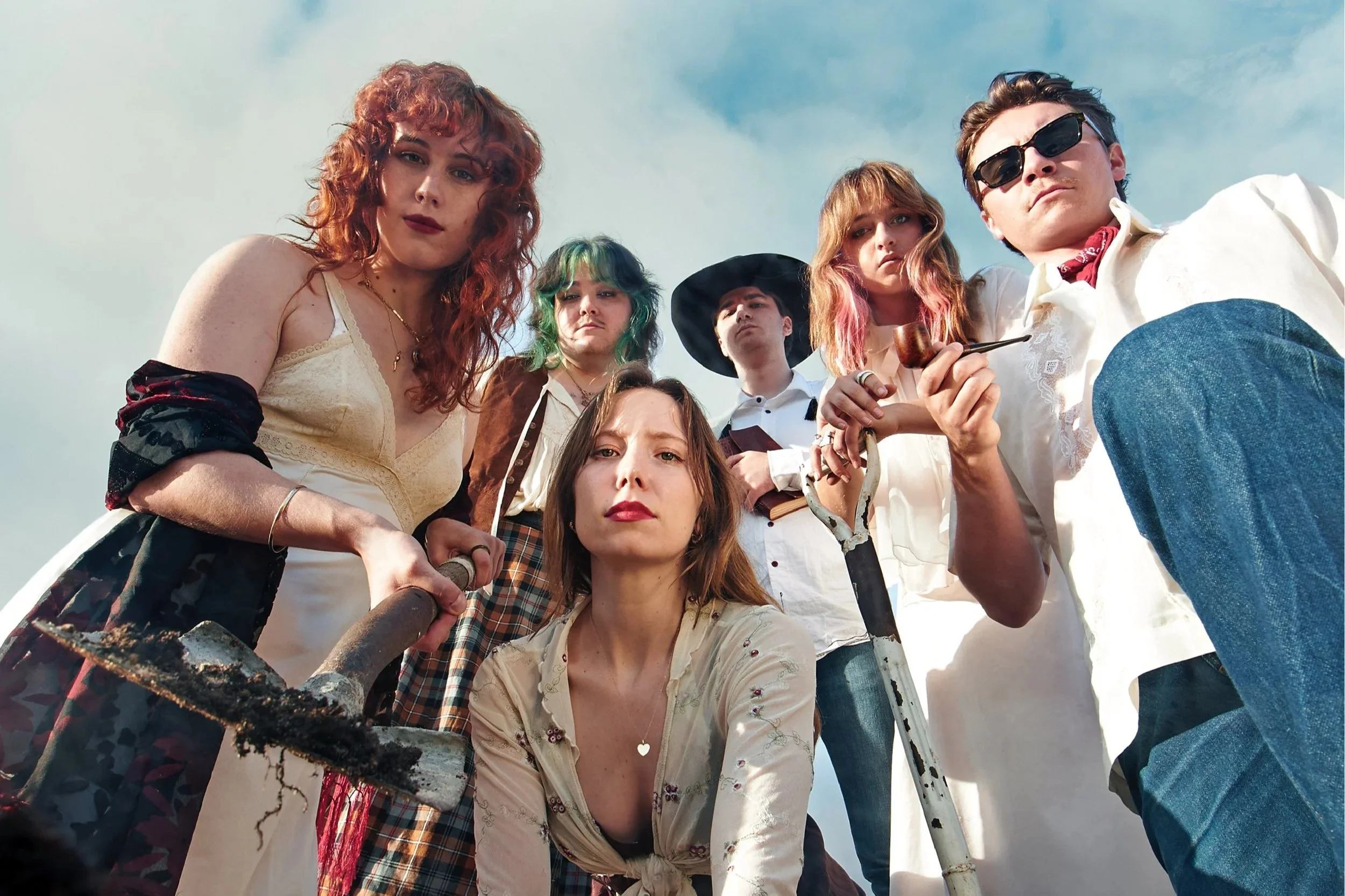
SELENE AND THE STRANGE
On their latest single ‘Junkyard’
Written by Siena Robb
For people discovering you for the first time, who are Selene and The Strange in one sentence?
“Medieval sapphic synth rock” is how they describe their sound.
The Sydney-based band Selene and the Strange are carving out a space of their own within the alternative landscape, balancing emotional depth with quiet restraint. Their music fuses synth textures, warm strings and understated rhythm into songs that value atmosphere and sincerity over spectacle. Those same qualities sit at the core of ‘Junkyard’, a song that doesn’t announce itself loudly, but instead unfolds at its own pace.
The Emotional Starting Point
What was the emotional starting point for Junkyard?
“The person that it’s about has seen me play it, ‘Junkyard’ is like your first doomed queer relationship, where you’re both figuring out who the f*ck you are, who you want to be to the world and kind of just about knowing something is going to fail and still doing it, so that was that.”
That sense of inevitability, choosing to stay even when you already know the outcome is what gives ‘Junkyard’ it’s quiet weight. The song doesn’t chase urgency or resolution. Instead, it lingers in the space between awareness and action, allowing mood and texture to do the emotional heavy lifting. Rather than relying on dramatic shifts or obvious hooks, ‘Junkyard’ moves in subtle waves. There’s restraint in the arrangement, a confidence in letting things breathe. Nothing feels overcrowded; every element exists without competing for attention. It’s a song that trusts the listener to sit with it.
Was this a song that came together quickly, or did it go through a few variations before landing where it is now?
Sam explained that Lydia had the demo, and told her “this sounds fu*king great!” As Sam encouraged Lydia to bring the potential track into the Selene and The Strange horizon, six months later the band had a ten-minute recording of themselves playing the full song together at the end of rehearsal.
“We jammed, played it once and was like this is it!” Zoe exclaimed.
“Coming to the band I already had a lot of ideas in my head, I just wanted to make it easy for people to come on board and this was the one song I just had nothing for chords and these guys just brought it to life.” Lydia shared.
That organic, almost immediate sense of arrival shows in the final recording. The production leans warm and organic, lyrics and rhythm working together to create a steady, almost conversational flow. Instead of building toward a traditional chorus payoff, the song holds tension through restraint, revealing small details over time rather than demanding immediate impact.
Finding It’s Life Outside the Room
Outside the rehearsal space, Junkyard quickly became something shared.
Lydia explained “We’d been to Saddle Club for the last few weeks- me and my friends, I played them the recording, they loved it!” Immediately Lydia had her friends offering their line dancing choreography skills into the mix.
From the beginning, the band shared a mutual mission: bring back dancing at gigs. That balance of emotional subtlety paired with physical movement feels central to ‘Junkyard’. The song may be reflective, but it’s never static. It invites motion without insisting on it, making space for listeners to experience it however they choose.
Lyrics & Vulnerability
Is there a lyric in Junkyard that feels closest to the bone for you?
The line that stood out most on first listen, first heard quietly on the piano in Lydia’s bedroom was “She collected postcard stamps”
It’s a deceptively simple line, but it carries a heavy emotional implication. It reads as a concise way of saying “someone doesn’t wanna stay somewhere,” capturing restlessness and impermanence without spelling it out. That lyric reflects the broader approach of Selene and The Strange’s writing. ‘Junkyard’ avoids being overly literal, but it stays grounded enough to feel immediately relatable. It focuses on emotional carry-over and the parts of past relationships that linger even when we think we’ve moved on. Memories, habits, and attachments don’t disappear just because we want them to, and Junkyard allows that truth to sit unresolved.
Band Dynamic
How do your individual influences clash or complement when you’re writing together?
“We all bring influence from somewhere different. I think it compliments our music because when we mix all our influences and sounds together, it just makes us a stronger band.”
That blend of perspectives gives ‘Junkyard’ its sense of balance. Lydia’s vocal delivery is calm and controlled, never overpowering the instrumentation but always anchoring it. The vocals sit confidently within the mix, creating a steady emotional centre that allows the song to feel reflective rather than heavy.
Misconceptions
What’s a common misconception people think about your band?
“That we’re all gay…you know what? Let them think that.” They laughed.
There’s an ease in the way Selene and The Strange navigate both perception and expectation; a willingness to let people project while staying firmly grounded in their own identity. Another misconception being that drummer Jordan must be in another band as well, like the majority of drummers. Well… he’s not and doesn’t intend to be! A true unicorn of the music world if you ask us.
Chemistry and Creativity
How would you describe the dynamic within the band creatively and personally and how does that show up in your music?
“We’ve only been a band for about nine months, and I feel like we’ve had a big year, we’ve had some really cool opportunities and we’ve done it all together. So it feels like we’re all heading toward something, we get better each time we play. We’ve grown so incredibly fast. We all sort of knew each other but never played together before. I think for us our dynamic really did just form from fun.”
That sense of enjoyment is tangible not just in how they speak about the band, but in how the music feels. ‘Junkyard’ never rushes to wrap its ideas up neatly. It exists as a moment of consideration rather than a conclusion, something you sit with rather than get pushed through.
“I feel like I have to train myself to not take things too seriously, cause otherwise I’ll stress about it and ruin it. You don’t have to do things the traditional way, just make mistakes, learn and have fun.” Says Lydia.
They also spoke about nerves and their differing timelines when it comes to stage fright. Guitarist Dylan emerged as the band’s calming, carefree presence, or their emotional anchor if you will. Drawing on his experience from his additional project Polar Eyes, Dylan shared insight into celebrating small wins and recognising progress as a newly formed band. A year before the band formed, Sam and Lydia spent each Tuesday writing songs purely for enjoyment, a practice that still shapes the band’s creative openness.
Live Energy & What’s Next
Is this single a standalone moment, or a hint at where you’re heading next for 2026?
“We are going to be recording an EP soon, and now we have an actual timeline for it for this year. We’ll be working with James Christowski who worked with us in his home studio for our first two singles.”
The band plans to take a brief step back from gigging while focusing on recording. The EP will include songs already familiar to live audiences, alongside new material currently brewing.“It’ll include songs that we actively play at our gigs now and some new things brewing for the body of work, oh and more photoshoots! We’re really looking forward to more collaborations and new connections as well as pushing the traditional boundaries of what a gig looks like.”
That sentiment feels like the quiet thesis of Junkyard itself. The song doesn’t overstate its emotions or demand attention. It trusts connection, patience, and subtlety. Their values clearly extend beyond their love for music and into the way Selene and The Strange move through the world together. It’s evident that Selene & The Strange truly love to perform, create, and collaborate. Their care for one another spills outward, and that energy is contagious on and off the stage.
“I think we all make it easy for each other to be ourselves, together as a group.”